The reasons › Doctrine and belief
God, Jesus, and spiritual experience
A minority lost faith in God or in Jesus; a larger group never received the promised witness, or stopped trusting the one they had. After leaving, a majority identified as agnostic, atheist, or humanist.
What members were taught
God answers sincere prayer. If you ask with real intent, you will receive a witness through the Holy Ghost, a burning in the bosom or a feeling of peace. If you have not received one, keep trying, and examine your worthiness.
What the record shows
A minority lost faith in God or in Jesus; a larger group never received the promised witness, or stopped trusting the one they had. After leaving, a majority identified as agnostic, atheist, or humanist.
Losing faith in God was not the main road out. About a quarter of respondents called it a major factor, and it mattered more to men and to those under thirty. Most people in the survey left Mormonism before, or without, leaving theism. But the destination is telling: asked how they identified now, 53% said agnostic, atheist, or humanist, 22% still called themselves Mormon in some sense, 11% had become Christians of another kind, and most of the rest were undecided.
Two findings stand out. The first is how many respondents had done exactly what they were told and received nothing. One in five said they never got the promised spiritual witness, despite sincere effort, and the written comments describe missions, temple marriages, and decades of callings carried on the hope that it would eventually come. The Church teaches that the witness is available to anyone who asks with real intent. Respondents who asked and did not receive were left to conclude either that they lacked intent, which they knew to be false, or that the promise was not reliable.
The second is that a re-evaluation of knowledge itself was more common than a loss of faith in God. Nearly four in ten said they had rethought what it means to know something. Once the Church's epistemology, feeling as evidence, stopped working for them, some found other grounds for belief in God and some did not. Either way, the Church's specific claims did not survive the change.
In their words
“I remember thinking, what is wrong with me, when I sit in the temple and I don't feel the spirit like everybody else says they do. And I got up in my singles ward and I bore my testimony about how I did feel it. I knew what to say.”

“And I never felt the spirit... Every day for a week, I would try to feel the wind rush, but I felt nothing. So this is on me. I'm broken.”
Quotes are taken from machine-made transcripts of Mormon Stories interviews and may contain small transcription errors. Each links to the moment in the recording so you can hear it for yourself.
What people actually name
From the crowd-sourced 2014 comprehensive list, lightly edited.
- Praying sincerely about the Book of Mormon, as instructed, sometimes for years, and receiving nothing.
- Promised blessings, including patriarchal blessings and priesthood blessings, that did not come to pass.
- The problem of evil and suffering, which the plan of salvation did not resolve.
- Concluding that belief in God was not justified by the reasons one had been given for it.
- Studying the psychology and neuroscience of belief and recognizing one's own experience in it.
- For a smaller number, a spiritual experience that pointed away from the Church, toward another faith or toward none.
Hear it first-hand
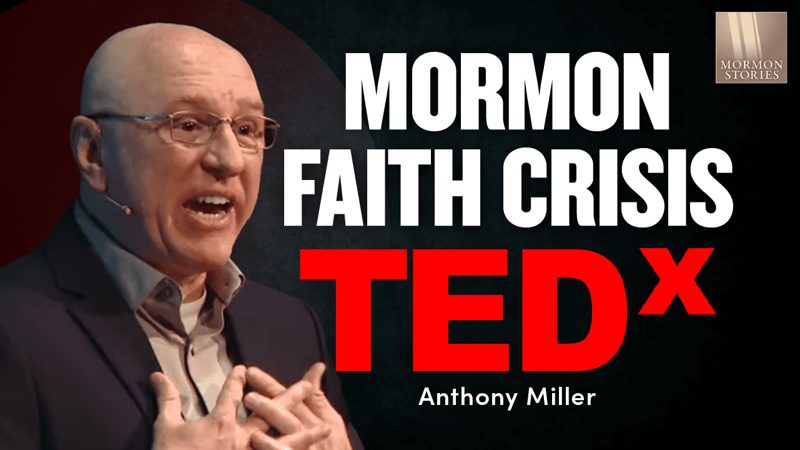 Mormon faith crisis journey, TEDx, with Anthony Miller Mormon Stories 1593, 2022
A faith crisis explained to an audience that had never heard of one.
More episodes on this, ranked
Mormon Stories interviews where this comes up most, beyond the ones chosen above.
-
 No Nonsense Spirituality w/ Britt Hartley | Ep. 1890
Mormon Stories 1890, 2024 · 126k views · hear a moment at 1:37:24
-
 1390: Undefining ‘God’ with John Hamer
Mormon Stories 1390, 2021 · 11k views · hear a moment at 7:00
-
 From Mormonism to Progressive Christianity – Randy Bell | Ep. 1533-1534
Mormon Stories 1533–1534, 2022 · 30k views · hear a moment at 2:52:32
-
 Kim Sandberg Turner – Navigating a Mormon faith transition as a Woman of a Certain Age | Ep. 701-704
Mormon Stories 701, 2017 · 11k views
-
 Confronting Nihilism After Mormonism w/ Brittney Hartley | Ep. 1840
Mormon Stories 1840, 2023 · 126k views · hear a moment at 1:43:52
-
 1373: Zelph on the Shelf – 5 Years of Laughter, Wisdom, Healing, and Growth
Mormon Stories 1373, 2020 · 64k views · hear a moment at 35:19
Ranked by the Mormon Stories episode recommender: what the transcripts say, what the titles and categories say, how widely the videos are watched, and what editors have pinned. Rebuilt with the site. Video plays here when you press play; the episode page has the audio and transcript.