The reasons › The founding claims
The Book of Abraham
Joseph Smith published a translation of Egyptian papyri. The papyri survived, Egyptologists can read them, and they are ordinary funerary texts from centuries after Abraham.
What members were taught
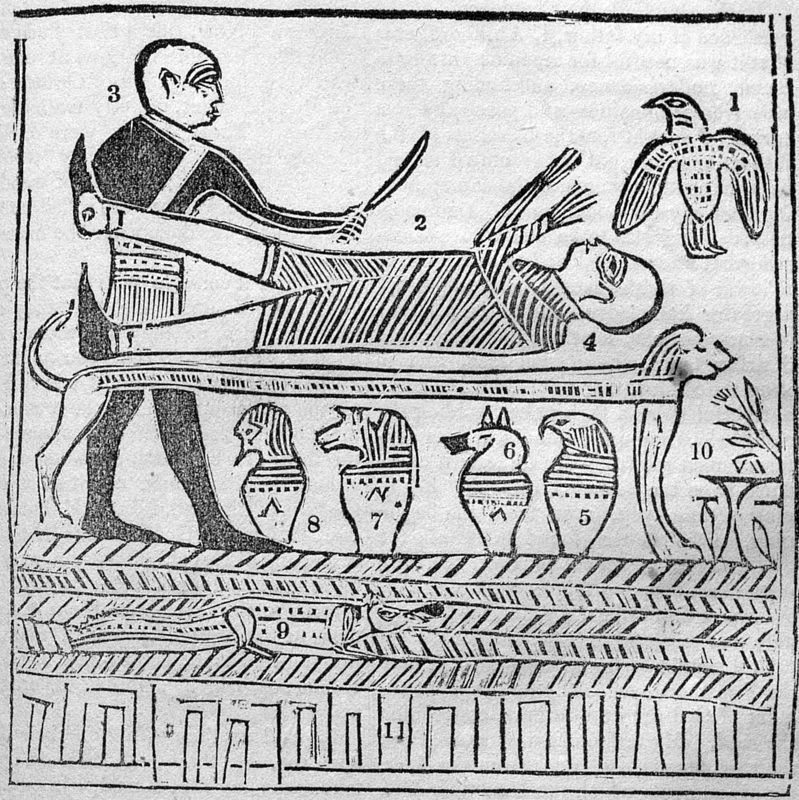
Joseph Smith translated a record written by Abraham's own hand on papyrus. The facsimiles in the Pearl of Great Price show Abraham on an altar, and the translation proves that Joseph could read ancient languages by revelation.
What the record shows
Joseph Smith published a translation of Egyptian papyri. The papyri survived, Egyptologists can read them, and they are ordinary funerary texts from centuries after Abraham.
The Book of Abraham is the one founding claim where the physical evidence is on the table. In 1835 Joseph Smith bought several Egyptian papyri from a traveling exhibitor and announced that one of them was written by Abraham "by his own hand upon papyrus." He published his translation, with three illustrations and his explanations of them, and the Church canonized it in 1880.
Egyptian could not yet be read in America in 1835. It can be read now. Fragments of the same papyri turned up at the Metropolitan Museum of Art in 1967 and were returned to the Church. Every Egyptologist who has examined them, inside the Church and out, reads them as standard funerary texts prepared for an Egyptian priest named Hor, roughly fifteen hundred years after Abraham would have lived.
The 2011 survey placed the Book of Abraham in a tie with polygamy as the single most damaging historical issue, and several respondents used the same phrase for it: the nail in the coffin. It was particularly important to men and to older respondents. What they describe is not a loss of faith in Abraham, but a loss of faith in the translator. If the one translation that can be checked turns out to be wrong, the ones that cannot be checked lose their standing too.
The Church's 2014 essay on the subject accepts that the papyri do not contain the Book of Abraham and offers the alternative that they prompted a revelation rather than being translated. Many respondents read the essay and found that it confirmed the problem rather than answering it.
What people actually name
From the crowd-sourced 2014 comprehensive list, lightly edited.
- The surviving papyri, rediscovered in 1967, are a Book of Breathings and other common funerary documents dated to roughly the first or second century BC.
- The facsimiles printed in the Pearl of Great Price are identifiable Egyptian vignettes, and Joseph Smith's explanations of the figures do not match what Egyptologists read in them.
- Joseph Smith's own "Grammar and Alphabet of the Egyptian Language" shows him assigning whole paragraphs of English to single characters.
- The text carries nineteenth-century ideas about astronomy and about lineage that were used for a century to justify the priesthood and temple ban.
What the Church has said
- Gospel Topics essay: Translation and Historicity of the Book of Abraham — concedes the papyri do not contain the text and proposes that they served as a catalyst for revelation
Hear it first-hand
 Dr. Robert Ritner, an expert Egyptologist, translates the Book of Abraham Mormon Stories 1341, 2020
The University of Chicago Egyptologist reads the papyri Joseph Smith translated, line by line.
More episodes on this, ranked
Mormon Stories interviews where this comes up most, beyond the ones chosen above.
-
 Book of Mormon Translation w/ LDS Discussions – 03 | Ep. 1585
Mormon Stories 1585, 2022 · 101k views · hear a moment at 2:33:05
-
 Top Mormon Historian Admits Issues Raised in CES Letter – Richard Bushman | Ep. 1934
Mormon Stories 1934, 2024 · 181k views · hear a moment at 2:39:35
-
 1344: Captain Kidd, Treasure Digging, Joseph Smith, and the Book of Mormon
Mormon Stories 1344, 2020 · 38k views
-
 Book of Abraham, Part 2: Translation Apologetics w/ LDS Discussions – 31 | Ep. 1707
Mormon Stories 1707, 2022 · 55k views · hear a moment at 42:29
-
 The Other Isaiah Problem in the Book of Mormon w/ Kolby Reddish LDS Discussions Pt. 69 | Ep. 2095
Mormon Stories 2095, 2025 · 17k views · hear a moment at 44:49
-
 Book of Abraham, Part 3: A Look at the Text Itself w/ LDS Discussions – 32 | Ep. 1710
Mormon Stories 1710, 2022 · 57k views · hear a moment at 2:07:08
Ranked by the Mormon Stories episode recommender: what the transcripts say, what the titles and categories say, how widely the videos are watched, and what editors have pinned. Rebuilt with the site. Video plays here when you press play; the episode page has the audio and transcript.
Go deeper
- Dr. Robert Ritner translates the Book of Abraham (Mormon Stories 1341) — an Egyptologist at the University of Chicago walks through the papyri
- LDS Discussions on the Book of Abraham