The reasons › The founding claims
Polygamy and polyandry
Joseph Smith married more than thirty women, some already married and some in their teens, while publicly denying it. For women in particular this was the fastest-rising reason in the survey.
What members were taught
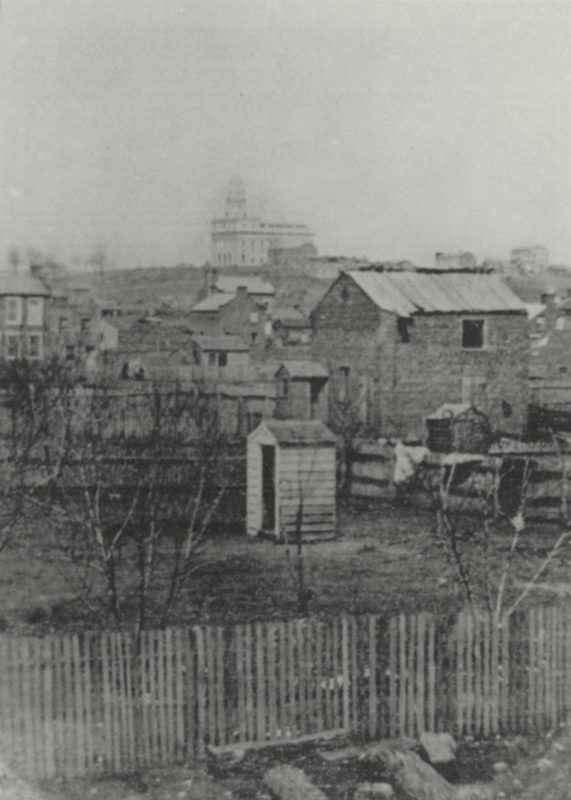
Plural marriage was a commandment given to Joseph Smith and practiced openly by Brigham Young and the pioneers, mostly to care for widows. It ended in 1890 when the Lord withdrew the commandment. Joseph's role in it, if mentioned at all, was reluctant and limited.
What the record shows
Joseph Smith married more than thirty women, some already married and some in their teens, while publicly denying it. For women in particular this was the fastest-rising reason in the survey.
Most members who grew up in the twentieth century knew that Brigham Young had many wives and that the practice ended in 1890. Far fewer knew that Joseph Smith started it, how he started it, or with whom. The 2011 survey found polygamy tied with the Book of Abraham as the most damaging specific historical issue, and the trend analysis found it was the second fastest-rising reason overall.
The details are what matter. Polygamy in the abstract is something members had already accepted. What they had not been told was that the founder married women who were already married to other men, that he married girls of fourteen and sixteen, that he did it without his wife's knowledge, that he denied it in public until his death, and that several of the marriages were preceded by promises of eternal reward for the woman's family or by the account of an angel threatening him with a sword if he refused.
Women rated this reason significantly higher than men, and their written comments explain why. The doctrine is not only history: Doctrine and Covenants 132 is still scripture, a widower may still be sealed to a second wife for eternity while a widow may not, and many women described realizing that the heaven they had been promised included sharing their husband. "I want to know what justifies polygamy," one respondent wrote. "I have to share my husband but he doesn't have to share me."
The Church published two essays on the subject in late 2014 that confirm nearly every item on the list below. Respondents in 2011 had learned it from other sources; the question the essays could not answer was why it had taken so long.
In their words
“Polygamy was always on my shelf. I did not know Joseph Smith practiced polygamy. And so that was, like, earth-shattering for me... right around that time I found the Gospel Topics essays, and I was following footnotes and reading and finding stuff... I'd been a member my whole life at this point, like 27, 28 years. I'd gone to seminary, I'd gone to institute, I'd read my scriptures, I watched every conference. I'd done all the things. And there was this information that I'd never come across, and it was shocking to me, and I felt lied to.”
“Threats that are going to happen to his beautiful daughter if she doesn't let his son marry more than one woman. It's just... My shelf broke and collapsed to the ground so fast.”
Quotes are taken from machine-made transcripts of Mormon Stories interviews and may contain small transcription errors. Each links to the moment in the recording so you can hear it for yourself.
What people actually name
From the crowd-sourced 2014 comprehensive list, lightly edited.
- No revelation on plural marriage was written down until 1843, years after Joseph Smith began the practice.
- Some of Joseph Smith's wives were already married to living husbands, several of them men he had sent on missions.
- Some were teenagers; Helen Mar Kimball was fourteen.
- Proposals that carried threats or promises, including the account of an angel with a drawn sword and promises of salvation for the woman's whole family.
- Public denials by Joseph Smith and other leaders while the practice continued.
- Emma Smith was not told about most of the marriages.
- Plural marriages continued in secret after the 1890 Manifesto, requiring a second Manifesto in 1904.
- The doctrine remains in Doctrine and Covenants 132, and men may still be sealed to more than one wife for eternity while women may not.
What the Church has said
- Gospel Topics essay: Plural Marriage in Kirtland and Nauvoo — confirms the polyandrous marriages and the marriage to a bride "several months before her 15th birthday"
- Gospel Topics essay: Plural Marriage and Families in Early Utah
- Gospel Topics essay: The Manifesto and the End of Plural Marriage — confirms post-Manifesto marriages
- Church History Topics: Joseph Smith's Marriages
Hear it first-hand
 Carol Lynn Pearson, The Ghost of Eternal Polygamy Mormon Stories 860, 2018
The poet and lifelong member on the doctrine that still shapes sealing policy and what it does to women.
 Discussing the new LDS.org polygamy essays, with Lindsay Hansen Park Mormon Stories 512, 2014
Recorded within weeks of the Church's 2014 essays confirming Joseph Smith's plural and polyandrous marriages.
More episodes on this, ranked
Mormon Stories interviews where this comes up most, beyond the ones chosen above.
-
 Polygamy Apologetics, Spiritual Wifery, etc w/ LDS Discussions – 29 | Ep. 1691
Mormon Stories 1691, 2022 · 77k views · hear a moment at 2:48:14
-

-
 Mormon Polygamy Apologetics w/ Sandra Tanner Pt. 2 | Ep. 1565
Mormon Stories 1565, 2022 · 67k views · hear a moment at 9:50
-
 Lindsay Hansen Park’s Year of Polygamy Ep. 551
Mormon Stories 551, 2015 · 143k views · hear a moment at 2:07:43
-
 D&C 132 – Joseph Smith’s Polygamy “Revelation” w/ LDS Discussions – 25 | Ep. 1676
Mormon Stories 1676, 2022 · 103k views · hear a moment at 57:43
-
 Emma Goes to War with Joseph Smith over Polygamy – John Turner Pt. 36 | Ep. 2133
Mormon Stories 2133, 2026 · 20k views · hear a moment at 2:19:57
Ranked by the Mormon Stories episode recommender: what the transcripts say, what the titles and categories say, how widely the videos are watched, and what editors have pinned. Rebuilt with the site. Video plays here when you press play; the episode page has the audio and transcript.
Go deeper
- Carol Lynn Pearson, The Ghost of Eternal Polygamy (Mormon Stories 860) — on the doctrine that still governs temple sealings
- Discussing the LDS.org polygamy essays with Lindsay Hansen Park (Mormon Stories 512)